Paws of War is helping veterans during COVID-19 lockdowns
NESCONSET, N.Y., April 27, 2020 /PRNewswire-PRWeb/ — When disabled veteran Hank Urnaitis answered the door, he wasn’t expecting Paws of War to be there, ready to help him through the pandemic. But that’s just what they did. The organization, which helps veterans and animals, stopped by to provide Hank with face masks and pet food. They also teamed up with Cambridge Catering to take him some prepared meals. When they looked around, they realized that he had some safety issues on his property that needed to be addressed, so they also got busy fixing those items, too.
“Hank is a decorated veteran who we paired up a service dog with back in 2016,” explains John Walis, veteran relations director of Paws of War. “We know he’s humble and didn’t want to take the assistance, but we wanted to give back to our veterans in need who won’t ask for help. It’s paramount that we are there for them and their service dogs now and in the future.”
After delivering the essential items, the Paws of War team took to helping with some safety issues that needed to be done. They fixed unsafe boards in the steps leading up to his home, replaced tattered flags in his yard, and fixed an area of his fencing a tree had fallen on.
The area of the fence that was down made it impossible for Hank to allow his dog to run around the yard, adding to his stress of trying to take him out for walks each day. By repairing the fence, Hank will be able to once again allow his dog to run free in the yard. All the supplies for the repairs were provided by Paws of War, and they provided the services free of charge.
Seeing the tattered flags be replaced with new ones was the biggest perk for the veteran. Being a proud veteran, the flags were a big deal for him. The organization is on a mission to help even more veterans through the pandemic, but they need the public to team up with them to help make it happen.
“We fight to save lives on both ends of the leash, and we are honored to be able to help Hank and other veterans just like him,” added Walis. “We use the donations that people give to us to help vets and pets. During this time there are many veterans who could use some additional supplies or assistance, and we will continue to what we can to help them. Donations are down, yet we have more veterans to help, so we really need the support of the community at this time.”
Pitbull rescued from dogfighting starts new life as veteran support animal
CINCINNATI — WCPO first introduced you to Promise in November 2019, when she was on the mend from being rescued.
“We found her abandoned at a home with a lot of evidence of dog fighting there,” Mandy Franceschina, owner of Rescued & Ready said. “She was the only alive dog we found on the premises.”
Franceschina had a goal to rehab and possibly train Promise, the gray pitbull-type dog, to be a service dog to a veteran as she’s done in the past.
“Echo (a previous rescue who was successfully paired with a veteran) took off, but other ones might not have the attention, they might not have the physical structure to hold up a full grown man,” Franceschina said.
Without the right skills, the focus turned to making Promise a comfort animal for a veteran instead. After one match-up fell through, Promise was discovered by an Army veteran almost 300 miles away in Lansing, Michigan.
“I was just thumbing through Facebook one day and I saw her picture — the one picture with flowers on her head,” Theresa Bousson said.
It was love at first sight, according to Bousson.
“I thought, ‘Oh my goodness, she’s so precious I have to see whose dog this is,’ and then I started reading her story and then was like … ‘aww,'” she said.
After applying to officially adopt Promise and undergoing a home visit, Promise was on her way to Michigan.
“When everything was good to go we were like, ‘Oh my God, we found her, we found her, this is perfect, we found her,’ and I got Promise in the car and drove to Lansing,” Franceschina said.
Promise has already started changed Bousson for the better.
“First of all, with everything going on, she has been a wonderful companion to me because me in this house — I have severe depression — it wouldn’t be working,” Bousson said.
Franceschina credits the veteran community with helping her find Promise a forever home by sharing her story online.
“We started reaching out to veteran groups and lot of veterans even reached out said, ‘My family is not the right fit, we have other dogs, we have small kids, whatever, we have cats, but this is awesome. Let me spread the word,'” Franceschina said.
Bousson said Promise is helping her in ways she didn’t even think about — from mental health to wellness.
“We’ve been doing about two to three miles a day,” Bousson said. “She needs it and I need it.”
For Franceschina, it’s another successful placement — another Promise fulfilled — with dreams of rescuing more pit bulls to help other veterans across the country.
How Dogs Will Cope After Lockdown
The coronavirus has been a testing time for most of us, but thankfully our dogs have been there for us to provide companionship and emotional support through unprecedented times.
But take a moment to imagine the upheaval that your dog must be experiencing. Days that were once full of long periods of quiet solitude are now filled with noise and bustle and people. It’s the kind of thing a dog could get used to. But since the lockdown (hopefully) won’t be lasting forever, canine advocates are urging people to start preparing their pooches for a return to the old normal.
In a statement today Becky Bristow of Dogs Trust Ireland said:
“Last year, we received over 2,300 requests from members of the public wanting to surrender their dog to us,”
“We are extremely worried that this figure could significantly increase this year if lots of dogs develop separation anxiety and become potentially unmanageable for their owners.
“Anxious dogs can panic when you leave, causing them to become destructive and damage your home, they can also bark and howl.
Bristow’s advice to dog owners is to implement a structured routine, which gives your dog some alone time. She even says its worthwhile to put your dog in a separate room.
She added that she is also concerned about the welfare of puppies that were purchased during the lockdown as people sought distraction and affection. These dogs will have to adapt not having their owners around all the time and will inevitably find it challenging.
“We are also worried that some people have rushed out and impulse bought puppies because they knew they would be at home for a few weeks. However, they may not have the time to commit to them when they return to work.”
The lockdown has posed so many challenges to the vulnerable members of our society, but lets not forget that its changed the lives of our pets as well, and they deserve the highest level of care whenever we emerge out of this crisis.
Dog stays connect with students virtually during remote learning
With students around the city learning remotely, teachers are digging deep to keep kids connected, and they’re turning to some four-legged friends for help.
Mushu is a member of the Department of Education’s Comfort Dog Program. He provides educational and emotional support at school to hundreds of sixth through eighth graders.
When New York City schools closed in March because of the coronavirus pandemic, Assistant Principal Philip Hammaack found a way to keep the comfort available to students.
“There’s a lot of research that indicates reading to dogs in person is a really great way for struggling readers…. As we’ve moved into remote learning, it’s been a way for us to connect with kids,” said Hammack.
For an hour each Wednesday afternoon, Hammack and his canine co-author host virtual storytime.
They read books like “Mushu Makes A Mistake” and “Mushu Goes To School” to sixth graders. They also tackle themes that are relevant to the times and give students a chance to talk about them.
Those experiences can also serve as inspiration for Mushu’s next story. Hammack says students are submitting ideas to keep the tales coming.
“The entire city is figuring out how to do this. And Mushu is just a tiny piece of that puzzle, but an important one,” said Hammack.
Inseparable retrievers are captured snuggling under the same blanket and watching the sunset together in heartwarming photos
The incredible bond between a pair of retrievers has been documented in a series of adorable photos.
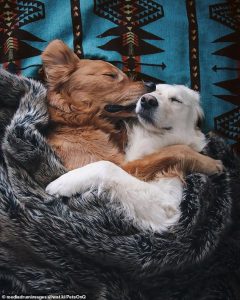
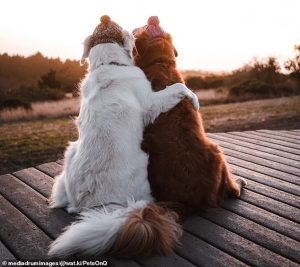
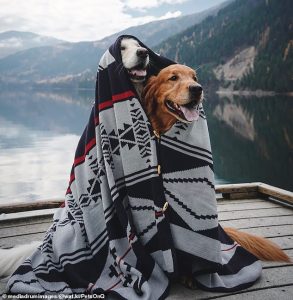
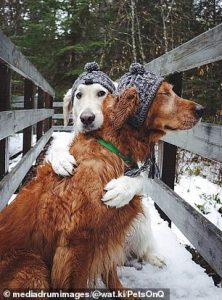
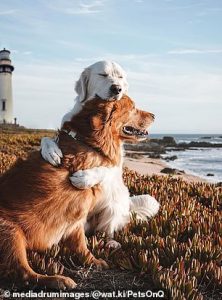
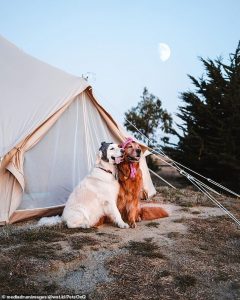

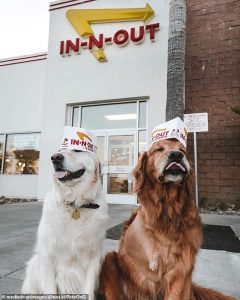
Golden-brown Kiko, eight, and five-year-old Watson, from Spokane, Washington, were introduced to each other in June 2015.
Owner and professional photographer Jennifer Medrano, 26, originally from Mexico,rescued Kiko at eight months old with Watson taking an instant shine to his adoptive brother.
‘I taught Watson how to hug,’ she said. ‘He knows many tricks but that’s his favourite. I was teaching Watson to hug when I was in the process of making our bond stronger.’
She said: ‘Their favourite things to eat are dog cookies and apples, and they always do everything together.
‘Sleep, cuddle, swim, eat. The love that these two brothers feel for each other brings so much joy.’
Jennifer was matched with Watson in January 2015 when he was seven weeks old to act as her emotional support dog in to help her with PTSD and social anxiety.
And the trio have formed an ‘extraordinary’ bond with Jennifer currently isolating with her two hounds in lockdown.
In a bid to spread joy, Jennifer set up an Instagram account, @wat.ki, for her pups to show their brotherly bond and to raise awareness for amputee dogs and those with cancer.
And the stunning pictures, taken using the Sony Alpha &R II, have attracted 930,000 followers with Jennifer documenting her dogs in the water, on hikes and cuddled up in bed.
‘I think their popularity is because of the love, connection and compassion they show in every photo or video. But also the lovely places they explore together,’ said Jennifer.
The events photographer said: ‘I met Watson on January 11 2015 when he was seven weeks old. He was meant to be my emotional support dog so it took me a while to find my perfect match.
‘I trained him all by myself, I have PTSD and social anxiety. So bonding with Watson and then Kiko have helped me so much.
‘Watson met Kiko when he was about eight months old. And they became instant friends.
‘It took no effort on my part to have them like each other. Adding Watson to my life has been amazing but having Kiko added to the mix has made it extraordinary.’
She continued: ‘Although I’m no longer close to and in communication with their previous owners, I’ll always be grateful I was able to get Kiko and give him a chance of a better life full of love and adventure.’
She revealed how Watson can be picky when it comes to canine friends but took an instant liking to Kiko.
And Watson is the only dog Kiko tolerates,’ she continued. ‘He wouldn’t let other dogs get near him at first. He was an aggressive dog at first, so I was worried he wouldn’t get along with Watson.’
However despite their adventurous lifestyle, Jennifer is still having to support Kiko through his cancer battle.
She said: ‘Kiko is still battling cancer sadly but he is doing a great job at fighting it.
‘As a family we all dedicated our time to help him get through it all with love. Next month will mark a year since his operation on the 29th.’
Dog is apparently first in U.S. to test positive for new coronavirus
The pet dog of a family taking part in a study at Duke University is apparently the first in the U.S. to test positive for the virus that causes COVID-19.
Dr. Chris Woods, the lead investigator of the Molecular and Epidemiological Study of Suspected Infection (MESSI), confirmed in a statement to CBS News that, “To our knowledge, this is the first instance in which the virus has been detected in a dog. Little additional information is known at this time as we work to learn more about the exposure.”
Early last month, Hong Kong health authorities said a coronavirus patient’s pet dog that tested positive for the virus was “likely” the first case of human-to-animal transmission.
WRAL-TV in Raleigh, North Carolina, which was first to report the U.S. development, said the dog, a pug named Winston, is part of a family in Chapel Hill.
The mother, father and son in that household were enrolled in the study and tested positive as well, WRAL said.
But another family dog and a cat didn’t test positive. The family’s lizard wasn’t tested.
The station quoted the mom, Heather McLean, a pediatrician at Duke, as saying Winston was having mild symptoms.
Ben McClean, the son, told WRAL that Winston “licks all of our dinner plates and sleeps in my mom’s bed, and we’re the ones who put our faces into his face. So, it makes sense that he got” the virus.
According to WRAL, the McLean’s daughter, Sydney, was the only family member who didn’t test positive. Her husband works in the emergency room at UNC Hospitals.
Therapy dog visits neighbors
Therapy dogs are essential in keeping people comforted and calm, but because of the COVID-19 pandemic, they have not been able to visit patients in the hospital.
However, one local therapy pup is still finding a way to improve the lives of others.
“Molly, lets go say ‘hello,’” Molly’s owner, Bob Rentz said.
Molly is a 9-year-old shepherd mix and an intuitive therapy dog who brings affection, support and comfort wherever she goes.
“Hi Molly!” Michaela Fredericks said.
Molly is used to spending her time visiting hospital patients and staff.
“She will actually pick up on the condition of the patients. If it’s a particular day where there is more than one patient who is having a rough day, she’ll get exhausted and come home and curl up and say ‘I’m drained,’” Rentz said.
But as COVID-19 started to spread, hospital visitors, like Molly, became restricted. That meant Molly wasn’t suiting up in her special vest. Rentz could sense she was confused.
“It seemed like she would look up and say, ‘Don’t you know what time it is? It’s time to go, what’s happening here?’”
Rentz decided to put up a post on the Nextdoor app to ask neighbors if she could come visit – a quick hello, a belly rub – as a way for Molly to still feel needed.
“She’s soft and kind,” 10-year-old Michaela Fredericks said.
Turns out those neighbors were in need of a little puppy therapy, too.
“It just feels good to have a dog come visit,” Fredericks said.
“We have a little boy who always loves to see Molly,” neighbor Krista Glodt said.
The Centers for Disease Control says at this time there is no evidence that animals play a significant role in spreading the virus that causes COVID-19.
So, until things can get back to normal, Molly will continue to spread happiness.
“She can just look somebody in the eye and say, ‘Everything’s okay, the world is going to keep spinning. It’ll be alright.’”
Molly lives in the Eagle Shadow neighborhood of Brighton, and Rentz says neighbors can request a visit from her.
Coaching therapy dogs
Disability services worker Rob Hosking has received over-the-phone coaching for his therapy dog Missy, all for free.
In exchange he gave the woman who trained his dog advice to better navigate the complex National Disability Insurance Scheme, to help her son who has autism.
The pair linked up on Learn This Teach That, a website born out of the COVID-19 restrictions and sharp downturn in the economy.
Byron Bay resident Leo Bellis-Jones created the platform after seeing his close friends struggling to keep their small businesses afloat.
“It was heartbreaking to watch something that took years and years to build go down in a matter of weeks,” he told AAP.
Soon there was an abundance of talented people without a job and stuck in isolation. Many others had time to learn a new skill or needed help to keep their business operating.
“As soon as money stops flowing there is no way to connect two people who want to exchange services. I wanted to find a new way for people to connect,” he said.
After Mr Hosking’s contact hours started to diminish, he stumbled upon Learn This Teach That via Instagram and was drawn to the idea of a cashless economy.
“At this time people don’t have a lot of money to barter or exchange but what we do have is a lot of time,” he told AAP.
After posting about his skill set he found a professional dog trainer.
“My therapy dog Missy is a very important part of my work, I’m always looking at obedience training for her,” he said.
Through phone conversations and a video chat he was able to pick up new techniques to keep her temperament calm in stressful situations.
In return he looked over her son’s NDIS plan and gave her advice to best utilise the funding and connect with services.
“It feels a bit like back to the old days, I think there is a bit of nostalgia about it,” Mr Hosking, who’s also from Byron Bay, said.
“I think about stories my grandparents would talk about, you would go and fix someone’s car and they would mow your lawn.”
While Mr Bellis-Jones was working in marketing in London, he became interested in social businesses after helping out a project for a youth homeless charity.
“I’ve been thinking for a while about how it seemed the economic model of the world is a little broken,” he told AAP.
“Companies are so focused on generating profits for shareholders and not thinking about their impact on the world,” he said.
“I wanted to rethink the concept of value exchange between people.”
Relocating to Australia he was warmly welcomed by locals, surprised by their openness, kindness, and generosity.
“When COVID-19 hit I wanted to find a way to give back to communities, and to help Aussies and their businesses,” he said.
He built the website in a day, with the help of a graphic designer, and since launching on April 14 he’s had more than 200 people sign up from countries including Sweden and India.
He’s been blown away by the breadth of skills pitched, which include everything from interpretive dance, to permaculture skills and SEO training.
After the health pandemic subsides, Mr Bellis-Jones still thinks there’s a future for “radical reciprocity”.
Tips for training
Caroline Gresham and her family have been thinking about adding a new member to their family for a couple of years.
So her family, like many others, decided that now might be the chance since they are spending more time at home.
“Zachary (Dad) spent an hour one day pretending to be a dog for the kids. After that he was like, ‘It’s time. We’re getting a dog,'” Gresham said.
“She goes a little crazy on walks when she sees another dog. We’d like to train her to walk better.”
Their story probably sounds familiar to many new dog owners. Sheltering at home has its advantages for adopting and training new pets, including more time for walks and play.
But in-person training classes with professionals are restricted, and social-distancing rules mean you can’t socialize a new dog at a park.
Here are a few things that new owners can keep in mind to help train their new best friend while stuck at home.
Like meetings, parties and family gatherings, dog training has pivoted to video conferencing. There are plenty of online resources and videos for training tips, but Mark Spivak, a professional dog trainer for over 30 years, says to make sure you’re finding the right resource for your dog.
“Each dog and family are unique. Internet media and books pose the disadvantage of not customizing instruction for the characteristics of the dog and family,” said Spivak, president of Comprehensive Pet Therapy. “Moreover, videos and print media do not provide feedback.”
Socializing your dog with new people and other dogs is an important aspect to get them adjusted. It’s especially important for puppies. But there are things you can do to help your pup get used to a new environment while staying safe.
“You can still expose your dog to riding in the car. You can still take your dog for a walk,” Stilwell said. She says if puppies have had their vaccinations, then you can put them in your arms and carry them out for a walk.
“Remember socialization is not just about touching. So just by going for a simple walk, that is exposing your puppy to a whole load of different experiences. They are seeing different people, they’re seeing other dogs.”
Don’t forget alone time for socializing your new pet. While being available right now for your new dog’s every barking command can be great, you do not want separation anxiety when you do need to leave them alone. Stilwell suggests leaving your new dog in a different room a little bit every day.
Spivak says that giving dogs time inside their crate can be helpful for housetraining puppies and breaking in older dogs to new homes.
“The crate reduces the probability of housebreaking and chewing errors during times when the family can not supervise the pet.” And, Spivak adds, “At least until the dog becomes comfortable with new routines, outdoor toileting areas, and existing household pets.”
Whether you have a brand new puppy or an older adult dog, use some of your extra time at home to teach your dog new tricks and skills.
Spivak says even though you may have time for long training sessions, dogs work better when the sessions are broken up.
“Obedience training practice is best conducted in multiple short sessions. While working from home there is more flexibility to apply several five-minute sessions versus a lengthy half-hour session.”
Also, keep in mind that dogs are learning even when you are not teaching them. No matter the breed or age, if you put in some time and effort, dogs will probably surprise you with what they can learn. Stilwell says that she’s been teaching her Chihuahua to help her find her keys.
The Gresham family says they might still seek some professional help once they are able to meet trainers in person again, but overall their new family member has been a welcomed addition.
“She’s perfect for the kids.They play with her all day. Overall, it’s been amazing.”
Therapy Dog’s third birthday
The Marion County Sheriff’s Office celebrated the third birthday of Crime Victim Therapy Dog “Caj” Sunday.
MCSO said on Facebook Caj moved to Marion when he was five months old and became the first Crime Victim Therapy Dog in the state.
Since, the sheriff’s office says Caj has “shared his love with hundreds of school children, nursing home patients and first responders of every kind.”
Most of all, the agency says Caj has helped some of their own through some of the “darkest days” of their lives.
“Caj holds us together,” MCSO said online
Happy Birthday, Caj!